
Today's links
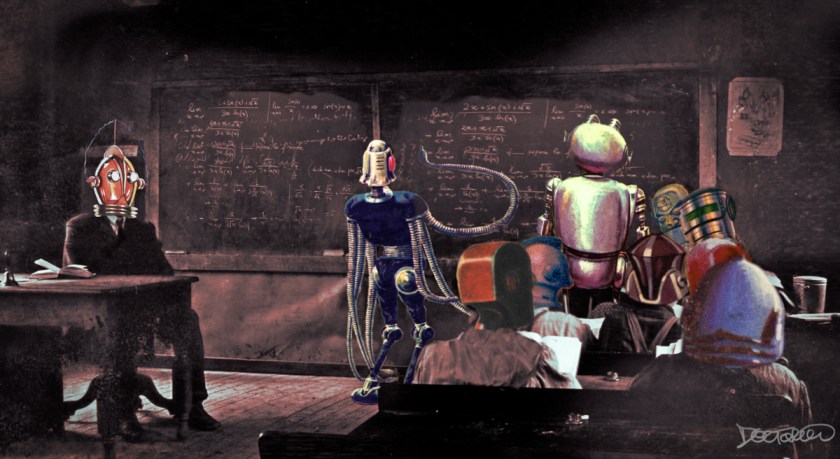
- Separable: AI makes us deal with paintings without painters, words without writers and mathematics without mathematicians.
- Hey look at this: Delights to delectate.
- Object permanence: Haircase; There's no copyright policy; Sole and despotic dominion; Trump x fraud; Brexit requires an act of Parliament; Official Air Travel Replacement Knives; UK hospitals v malware.
- Upcoming appearances: Kilkenny, Courtenay, Vancouver, Folkestone, Oxford, Sheffield, Virtual, Oxford, Montreal.
- Recent appearances: Where I've been.
- Latest books: You keep readin' em, I'll keep writin' 'em.
- Upcoming books: Like I said, I'll keep writin' 'em.
- Colophon: All the rest.
Separable (permalink)
Long before the Turing Test, there was the touring Edison Test: from 1915 to 1925, the scoundrel Thomas Edison put on a traveling show for his phonograph machine, touring venues around the USA. Edison set live performers and an Edison phonograph playing behind closed curtains that would be periodically pulled aside to reveal that the music the audience had taken to be live performance was actually a record player:
https://www.tomedison.org/blog/edisons-tone-tests
Now, if you've ever heard an Edison phonograph, this might seem like yet another tale in which old-timey people are revealed to be credulous yokels. You would never mistake one of those scratchy, hissing recordings for a live performance:
https://www.youtube.com/watch?v=96gIIFmEjY4
And indeed you wouldn't, but not because the phonograph predates the evolution of the human brain's anti-credulity lobe. The reason old-timey people couldn't tell the difference between a phonograph and a live performance was that before the phonograph, every live performance had a performer.
The two were inseparable, and so when you encountered the sound of a musical performance, your brain would insist that there must be a performer as well. This is a well-understood principle in swindles, magic tricks and literature. It's the basis of Douglas Adams' towel gambit:
For some reason, if a strag discovers that a hitchhiker has his towel with him, he will automatically assume that he is also in possession of a toothbrush, washcloth, soap, tin of biscuits, flask, compass, map, ball of string, gnat spray, wet-weather gear, space suit etc, etc. Furthermore, the strag will then happily lend the hitchhiker any of these or a dozen other items that the hitchhiker might accidentally have "lost."
All persons heretofore encountered in possession of a towel had all that other stuff, so the mere presence of a towel evokes an overwhelming intuition that all that other stuff must be nearby.
Like every conjuring trick and every swindle, this cognitive illusion swiftly regresses to the mean. After a few exposures to phonographs, the manifest differences between live performance and recordings become impossible to miss, and you stop making that mistake.
If one thing always signifies the presence of another – if a towel always implies a backpack full of supplies or if a performance always implies a performer – there's no reason for you to entrain the neurological patterns needed to detect the performance without the performer. This doesn't mean that it's hard to develop the capacity to make this distinction, just that the ability to detect a phenomenon always post-dates your encounter with that phenomenon.
You've no doubt guessed by now that this is an analogy about AI. The implication of this ability to learn to discern differences after you encounter them (but not before) implies that a chatbot might pass the Turing Test at its introduction, but then come to fail the test after we've all had the experience with it that lets us tune our perceptions to spot the differences, which then become as unmissable as the needle hiss on a phonographic reproduction of a concert pianist.
This is an experience many of us have already had. Prior to chatbot-generated prose, we'd never had experience with writing that didn't have a writer. Prior to image-gen output, we'd never had experience with paintings that didn't have painters. At first, the output from these models was remarkable, and often indistinguishable from human-generated words and images. Even knowing that these works were extruded by an algorithm, it was hard to shake the conviction that they were the product of human creativity. These works were "eerie," in the sense that Mark Fisher uses, "the seeming of intent without an intender":
https://pluralistic.net/2024/05/13/spooky-action-at-a-close-up/#invisible-hand
Just like the strag inferring the existence of "toothbrush, washcloth, soap, tin of biscuits, flask, compass, map, ball of string, gnat spray, wet-weather gear, space suit etc, etc," we automatically imputed to these works both a creator and a creative impulse. We supposed that their words and brushstrokes represented aesthetic and technical choices emanating from human creators who meant something by them (or at least were so satisfied by the accident of their appearance on the page that they left them stand). These creators were figments of our imagination. No one is home inside the AI. The intentionality we imputed to these works was the actual "AI hallucination":
https://pluralistic.net/2026/09/21/sunsetting/#oh-mr-sun-sun-mr-golden-sun-please-shine-down-on-me
Just as important as the emergence of these hallucinations is their disappearance. For many of us, chatbots that used to pass the Turing Test now flunk it. The chatbots haven't gotten worse at impersonating humans, we've just gotten better at spotting the difference between a human and a bot, just as we got better at hearing the difference between a phonograph and a pianist.
Writing without a writer and paintings without a painter are new phenomena, and learning to separate the formerly inseparable is the first step in our societal metabolization of these novelties. Recordings of musical performance have a place in our world, and so do performers.
This separation process is currently underway in many disciplines, thanks to the extraordinary capital available to AI companies. These companies are incinerating that capital in a series of extremely flash demos that are intended to ensure that the supply of bales of $100 bills that they feed to their money furnaces ("data centers") never stops.
Lately, AI companies have made headlines with a series of mathematical accomplishments that left mathematicians in an uproar and non-mathematicians in a muddle. Obviously, while mathematicians are qualified to assess these accomplishments, the rest of us are not. Beyond simple arithmetic, most of us don't do a lot of math on a regular basis, and even those of us who have to deploy a little geometry or stats typically don't engage with math at a theoretical level.
To make things worse, math – like physics – is a crank-magnet. These highly abstract, closed systems rely on introspection to advance the field, and some of those advances have been contributed by untrained laity, so it can be hard to know if your amazing idea about physics or mathematics represents an outsider's breakthrough or an amateurish cul-de-sac.
Every mathematician and physicist I know receives a steady stream of breathless, over-the-transom "proofs" that solve some long-standing problem in the field, and none of these experts in my orbit has ever found a breakthrough in this material. It's a rare expert who will even respond to these unsolicited manuscripts. That's not their job. As Teresa Nielsen Hayden says, "You are not responsible for the things you do in other people's dreams."
Unfortunately, this is a situation that is perfectly suited to AI. If you've introspected your way into a mathematical "breakthrough" that no mathematician will discuss with you, you can avail yourself of any number of chatbots who will assure you that you've broken exciting new theoretical ground, and these chatbots will even act as "research collaborators," contributing more slop-physics or slop-math to your conclusions.
Again, as far as I know, no one has actually made a breakthrough this way, and the major impact on the field from giving chatbots to excitable outsiders has been to make the unsolicited manuscripts much longer, with the veneer of professionalism that means an expert might have to give them a second or even third glance to realize that they're nonsense.
But some working mathematicians have found chatbots to be extremely useful "collaborators." The most prominent of these is Terrence Tao, a Macarthur-winning mathematician who has excited many mathematicians and lay-people alike by publishing his chat-logs and the resulting mathematical work:
https://pluralistic.net/2026/07/28/hitl-ers/#ai-ai-oh
One way to understand Tao is as a "centaur," the automation theory term for a worker who is assisted by a machine. For all that Tao describes Chatgpt as his collaborator, it's clear from reading the chat-logs that it's Tao who drives the research agenda. He sets the questions and the direction of the answers. Chatgpt doesn't give him orders – it's the other way around.
But for every problem Tao and Chatgpt solve together there are several mathematical problems that are being solved by chatbots without that kind of human collaboration. In particular, Openai has released a tsunami of "solutions" to longstanding mathematical problems, including some that carry large cash bounties and others that were posed by legends of the field, like Erdos.
This is mathematics without a mathematician, and – as with all the other separations cleft by the AI companies – it's proving difficult to metabolize. Back in September, Fenner Stanley Tanswell published an opinion piece for the Mathematical Intelligencer entitled "The Enshittification of Mathematics" that tried to do just that:
Tanswell distinguishes between mathematics as a discipline practiced by mathematicians and the proofs and theorems that those mathematicians produce. He makes the point that when a mathematician finds the answer to some longstanding mathematical puzzle, they do so by creating "scaffolding" that bridges the new insight with the existing commons of mathematical understanding. The thing that makes a "solution" so exciting isn't that a problem has been solved – it's that the method for solving that problem prompts a cascading reconsideration of many other areas of mathematics, prompting shifts to large areas of the discipline.
This point is made even more forcefully by Giordano Scarciotti, a complex systems researcher at Imperial College London and science communicator who vlogs under the Youtube handle "Prof Gio." Scarciotti's most successful video to date is "You Truly Don't Understand What Just Happened to Mathematics," published last month:
https://www.youtube.com/watch?v=KqiDqJMxg6o
"You Truly Don't Understand…" makes a similar point to Tanswell's, using a thought experiment in which we wake up one day and discover an American flag on the surface of Mars. Without knowing how that flag got to Mars, the mere fact of its existence doesn't help us get any closer to an actual Mars mission.
The output of mathematical models is a series of faits accomplis, often accomplished through brute-force, or sometimes through opaque methods that lack the "scaffolding" that bridges these outcomes into the broader field of mathematics. Scarciotti cites Euler's work on the longstanding "Seven Bridges of Königsberg" problem, which asked whether it was possible to go on a walking tour of Königsberg such that you crossed each of the city's seven bridges only once:
https://en.wikipedia.org/wiki/Seven_Bridges_of_K%C3%B6nigsberg
The point of that problem (and Euler's solution to it) wasn't to produce a set of Mapquest directions for a walking tour of Königsberg. In solving the Seven Bridges problem, Euler invented graph theory, an important area of mathematics that is routinely used today for many important applications, including computer networking. You can thank graph theory for helping to route the packets that brought these very words to you.
So far, we've figured out how to get a model to either rule out the possibility of taking that each-bridge-only-once walk or to give us the route map. What this computer-generated "mathematics" is not doing is advancing the field.
Tanswell points out that a world in which chatbots "solve" these problems is one where the role of mathematicians is reduced to being reverse centaurs, assistants to the machine whose job is to clean up after the chatbot's research agenda. But there's nothing about knowing that there's no route map for a seven-bridge walking tour that makes it easier to invent graph theory, and a mathematician might spend years working on the computer's "answer" to that problem only to conclude that the computer's solution didn't add any theoretical insight to the field.
In other words, in a world where mathematicians and mathematics are inseparable, every solution to a longstanding problem heralds an accompanying theoretical insight. Once we separate mathematics from mathematicians, we start to get solutions without insights. These are a lot less interesting than the kinds of solutions that mathematicians come up with.
This is a distinction the AI companies really don't want us to dwell on. We're meant to marvel at these very expensively derived solutions and conclude that the AI companies can be forgiven for spending $1T this year, even if they only grossed $50B in return.
But (as Scarciotti notes), there are real-world consequences in our failure to grasp this distinction: if we convince early-career mathematicians and promising mathematics students that the world no longer needs mathematicians because "the AI can do their jobs," then we will choke off the supply of future mathematicians who we'll either need to work in a Terrence Tao-like, centaurish relationship with chatbots (good), or even to serve as reverse centaurs, marking the chatbots' homework to see if there are any theoretical insights to be found in it (bad).
This is one of the underappreciated consequences of AI mania. AI bosses are particularly interested in convincing us that AI can do the job of skilled professionals in fields where there is a chronic undersupply of experts, like radiology. A chatbot that helps a (centaur) radiologist by suggesting that they double-check some of their results might indeed save lives. But a chatbot that produces thousands of radiology reports for a single (reverse centaur) radiologist to approve at a velocity that precludes careful scrutiny is going to kill people.
Centaur radiology requires more radiologists, not fewer. A centaur radiologist processes fewer X-rays (because sometimes the chatbot tells them to double-check a diagnosis) than an unassisted radiologist. LLM-assisted radiology improves quality, not quantity.
That's not what AI companies are selling. An AI company can't turn a profit by raising the cost of radiology (even if that improves the quality of radiological analyses). So the firehouse of announcements from AI companies are always about putting radiologists out on the breadline – not about needing more radiologists, who will get a new radiology tool that helps them work better, if a little more slowly.
The pronouncements of AI companies aren't just marketing hype, they're attempts at self-fulfilling prophecy. If you convince all the would-be radiologists that the profession is about to be vaporized by chatbots, those people will not study radiology, and then we will need to retask the dwindling supply of human radiologists to marking the chatbots' homework and hoping that they don't kill too many people by missing the chatbots' mistakes.
That's the catastrophic outcome that both Scarciotti and Tanswell warn us of: if we convince people that we're heading into a world of mathematics without mathematicians, that's exactly what we'll get, because no one will try to become a mathematician. But because mathematics without mathematicians is a set of guide maps for crossing Königsberg's bridges (but not graph theory), then mathematics without mathematicians is also mathematics without mathematics.
Hey look at this (permalink)

- The death of rss feeds?? https://www.reddit.com/r/goodreads/comments/1xhhcgi/the_death_of_rss_feeds/
-
Cardigan: a CARDIAC cardboard computer simulator https://lab.strangequery.com/cardigan/
-
Palantir AI tech unused or little used by 29 NHS trusts said to be benefiting from it https://www.theguardian.com/technology/2026/nov/02/palantir-unused-nhs-hospital-trusts
-
A.I. Stories in the Age of AI Hype: a Conversation with Ted Chiang https://buttondown.com/charliejane/archive/ai-stories-in-the-age-of-ai-hype-a-conversation

Object permanence (permalink)
#20yrsago EFF fights another DMCA abuser https://web.archive.org/web/20061104133502/https://www.eff.org/deeplinks/archives/004973.php
#15yrsago Staircase covered in a cascade of synthetic human hair https://web.archive.org/web/20111030014202/http://www.jessicawohl.com/hairy-stairs
#15yrsago Entertainment industry incredibly profitable, healthy: but demands special pirate-hunting laws anyway https://arstechnica.com/tech-policy/2011/11/piracy-problems-us-copyright-industries-show-terrific-health/
#15yrsago There is no copyright policy, only Internet policy; there is no Internet policy, only policy https://locusmag.com/feature/cory-doctorow-its-time-to-stop-talking-about-copyright/
#10yrsago Sole and Despotic Dominion: how a 20th century copyright law is abolishing property for humans (but not corporations) https://locusmag.com/feature/cory-doctorow-sole-and-despotic-dominion/
#10yrsago Police in Quebec are spying on journalists and Snowden calls that “a threat to democracy” https://web.archive.org/web/20161104150400/https://motherboard.vice.com/read/edward-snowden-quebec-police-journalists-spying-surveillance
#10yrsago Donald Trump weaponized fine-print to make it impossible to sue Wall Street for fraud https://www.ibtimes.com/political-capital/how-donald-trump-used-fine-print-make-it-harder-sue-wall-street-fraud-2440890
#10yrsago High Court tells UK government that Brexit requires a vote in Parliament https://www.bbc.co.uk/news/uk-politics-37857785
#10yrsago Artist celebrates Patriot Act’s anniversary by handing out “Official Air Travel Replacement Knives” to arriving SFO passengers https://hyperallergic.com/on-anniversary-of-the-patriot-act-artist-passes-out-pocket-knives-at-the-airport/
#10yrsago A journalist finally uncovers the root of Trump supporters’ anger https://www.theawl.com/2016/11/i-talked-to-some-trump-voters-too/#.z9k84oxsg
#10yrsago A fake HP printer that’s actual an office-camouflaged cellular eavesdropping device https://www.wired.com/2016/11/evil-office-printer-hijacks-cellphone-connection/
#10yrsago UK hospitals shut down by malware, advise patients to go somewhere else for the duration https://www.zdnet.com/article/computer-virus-attack-forces-hospitals-to-cancel-operations-shut-down-systems/
Upcoming appearances (permalink)

- Kilkenny (Kilkenomics), Nov 6-8
https://kilkenomics.com/ -
Courtenay: Enshittification (Sid Williams Theatre Society), Nov 10
https://www.sidwilliamstheatre.com/events/cory-doctorow-talks-enshittification/ -
Vancouver: BC Policy Solutions Gala, Nov 12
https://bcpolicy.ca/gala/ -
Folkestone Writers Festival, Nov 16
https://www.creativefolkestone.org.uk/whats-on/cory-doctorow-the-internet-is-broken-now-what/ -
Oxford: Ministry of the Future, Nov 23
https://ministryforthefuture.co.uk/events.html -
Sheffield: Reverse Centaur at Juno Books, Nov 25
https://www.outsavvy.com/event/40274/cory-doctorow-in-conversation -
Virtual: Enshittification, AI, and the Future of Technology (UBC Master of Educational Technology), Nov 28
https://met.ubc.ca/2026/09/met-speaker-series-cory-doctorow-enshittification-ai-and-the-future-of-technology/ -
Oxford: Bennett Oxford Symposium on Open Code in Science, Dec 9
https://www.bennett.ox.ac.uk/events/2026-bennett-institute-symposium/ -
Montreal: World Science Fiction Convention, Sep 2-6
https://montreal2027.ca/en

Recent appearances (permalink)
- Clint Eastwood (No Gods No Mayors)
https://www.patreon.com/NoGodsNoMayors/posts/clint-eastwood-173008088 -
Life After AI (Brain Bar)
https://www.youtube.com/watch?v=IPPa43-n0vI -
Terms of Service with Clare Duffy (CNN)
https://www.cnn.com/audio/podcasts/terms-of-service-with-clare-duffy/episodes/458ce968-af5d-11f0-b539-13ed2afe25f8 -
AI, Work, and Power (Software Engineering Daily)
AI, Work, and Power https://softwareengineeringdaily.com/podcasts/cory-doctorow-on-ai-work-and-power/ -
AI, Corporate Power, and the Fight for Worker Control (Plutopia)
https://plutopia.io/cory-doctorow-ai-corporate-power-and-the-fight-for-worker-control/

Latest books (permalink)
- "The Reverse-Centaur's Guide to AI," a short book about being a better AI critic, Farrar, Straus and Giroux, June 2026
https://us.macmillan.com/books/9780374621568/thereversecentaursguidetolifeafterai/ -
"Canny Valley": A limited edition collection of the collages I create for Pluralistic, self-published, September 2025 https://pluralistic.net/2025/09/04/illustrious/#chairman-bruce
-
"Enshittification: Why Everything Suddenly Got Worse and What to Do About It," Farrar, Straus, Giroux, October 7 2025
https://us.macmillan.com/books/9780374619329/enshittification/ -
"Picks and Shovels": a sequel to "Red Team Blues," about the heroic era of the PC, Tor Books (US), Head of Zeus (UK), February 2025 (https://us.macmillan.com/books/9781250865908/picksandshovels).
-
"The Bezzle": a sequel to "Red Team Blues," about prison-tech and other grifts, Tor Books (US), Head of Zeus (UK), February 2024 (thebezzle.org).
-
"The Lost Cause:" a solarpunk novel of hope in the climate emergency, Tor Books (US), Head of Zeus (UK), November 2023 (http://lost-cause.org).
-
"The Internet Con": A nonfiction book about interoperability and Big Tech (Verso) September 2023 (http://seizethemeansofcomputation.org). Signed copies at Book Soup (https://www.booksoup.com/book/9781804291245).
-
"Red Team Blues": "A grabby, compulsive thriller that will leave you knowing more about how the world works than you did before." Tor Books http://redteamblues.com.
-
"Chokepoint Capitalism: How to Beat Big Tech, Tame Big Content, and Get Artists Paid, with Rebecca Giblin", on how to unrig the markets for creative labor, Beacon Press/Scribe 2022 https://chokepointcapitalism.com

Upcoming books (permalink)
- "The Post-American Internet," a geopolitical sequel of sorts to Enshittification, Farrar, Straus and Giroux, 2027
-
"Unauthorized Bread": a middle-grades graphic novel adapted from my novella about refugees, toasters and DRM, FirstSecond, April 20, 2027
-
"Enshittification, Why Everything Suddenly Got Worse and What to Do About It" (the graphic novel), Firstsecond, 2027
-
"The Memex Method," Farrar, Straus, Giroux, 2027

Colophon (permalink)
Today's top sources:
Currently writing:
- “Once Is Enemy Action,” a science fiction novel about the origins of modern technofascism. Today's words: 512 (31870 total).
-
"The Post-American Internet," a sequel to "Enshittification," about the better world the rest of us get to have now that Trump has torched America. Fourth draft completed. Submitted to editor.
-
A Little Brother short story about DIY insulin PLANNING

This work – excluding any serialized fiction – is licensed under a Creative Commons Attribution 4.0 license. That means you can use it any way you like, including commercially, provided that you attribute it to me, Cory Doctorow, and include a link to pluralistic.net.
https://creativecommons.org/licenses/by/4.0/
Quotations and images are not included in this license; they are included either under a limitation or exception to copyright, or on the basis of a separate license. Please exercise caution.
How to get Pluralistic:
Blog (no ads, tracking, or data-collection):
Newsletter (no ads, tracking, or data-collection):
https://pluralistic.net/plura-list
Mastodon (no ads, tracking, or data-collection):
Bluesky (no ads, possible tracking and data-collection):
https://bsky.app/profile/doctorow.pluralistic.net
Medium (no ads, paywalled):
Tumblr (mass-scale, unrestricted, third-party surveillance and advertising):
https://mostlysignssomeportents.tumblr.com/tagged/pluralistic
"When life gives you SARS, you make sarsaparilla" -Joey "Accordion Guy" DeVilla
READ CAREFULLY: By reading this, you agree, on behalf of your employer, to release me from all obligations and waivers arising from any and all NON-NEGOTIATED agreements, licenses, terms-of-service, shrinkwrap, clickwrap, browsewrap, confidentiality, non-disclosure, non-compete and acceptable use policies ("BOGUS AGREEMENTS") that I have entered into with your employer, its partners, licensors, agents and assigns, in perpetuity, without prejudice to my ongoing rights and privileges. You further represent that you have the authority to release me from any BOGUS AGREEMENTS on behalf of your employer.
ISSN: 3066-764X